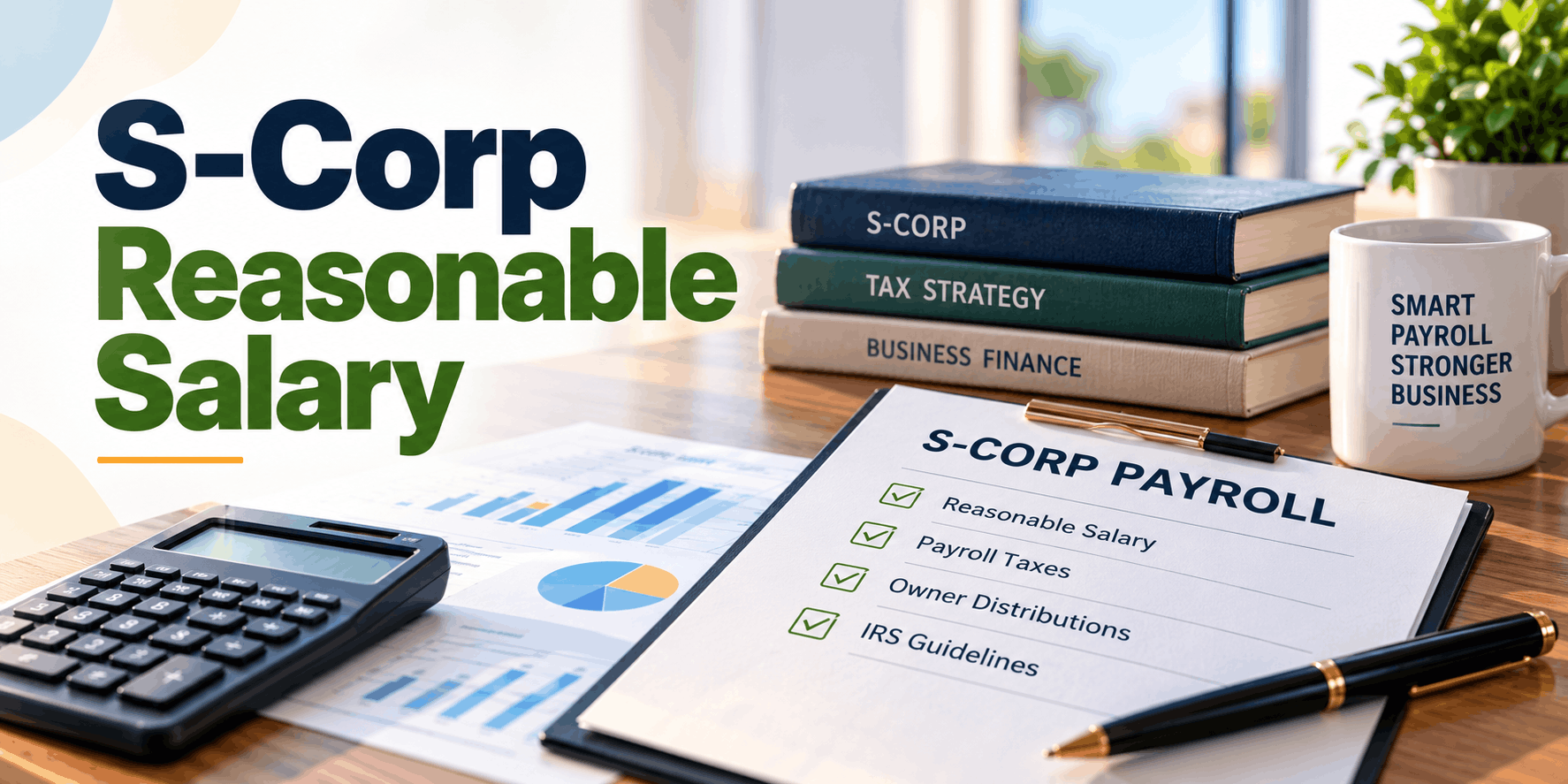
Elect S corp status and you become two people at once: the employer who cuts the paycheck and the employee who receives it. How much of your own money runs through payroll as wages, and how much comes out as profit, is up to you. That split decides your tax savings, and your S corp reasonable salary is the wages half of it.
Set that salary too high, and you hand over payroll tax you never owed. Set it too low, and you invite an audit. And if you work in California, one state tax the national guides tend to leave out quietly changes the math. Here is how to land the number and back it up.
What an S Corp Reasonable Salary Really Means
A reasonable salary is the pay a similar business would give someone else to do your job. That is the whole test. There is no formula and no percentage in the tax law, and the IRS treats officers as employees whose wages are judged on the facts of each case, the same way courts have judged them for decades.
It only matters once you take distributions. If your company earns little and you pay yourself nothing, there is no salary requirement to meet. The rule kicks in when profit starts flowing to you as an owner, because that is when splitting your pay into wages and distributions starts saving tax. Officers who do real work have to be paid real wages first.
Where the S Corp Savings Come From
Two kinds of money leave an S corp and land in your pocket, and they are taxed differently.
Salary is wages. It carries the 15.3% payroll tax that covers Social Security and Medicare, split between the company and you. Distributions are your share of the profit, and they skip that 15.3% entirely. You still owe income tax on them, just not payroll tax.
So every dollar you can reasonably move from salary to distribution saves about 15 cents in payroll tax, up to the Social Security wage cap, and the Medicare piece above it. That saving is the whole reason the election is worth the paperwork, and the reasonable salary rule is the guardrail that stops owners from calling all of it profit. If you have not made the switch yet, converting your LLC is the first decision, and the salary question comes right after.
How do you figure out a reasonable salary?
CPAs lean on three approaches, and the strongest analyses blend them.
| Method | How it works | Where the number comes from |
| Market approach | Match the pay for your role at an employer | BLS, salary sites, RCReports |
| Cost approach (many hats) | Price each job you do and blend by hours | Rates for each role you fill |
| Income approach | Check the profit left after your pay | An outside investor’s view of returns |
For the market approach, pull real numbers from the Bureau of Labor Statistics, from Glassdoor or Payscale, or from a paid, reasonable-compensation report. For a working screenwriter, producer, or musician, look up staff pay for the craft, not the headline star money. The cost approach prices each hat: if you spend 70% of your week writing and 30% running the business, blend a writer rate and an admin rate by those hours. The income approach asks whether an outside investor would accept the return left after paying you.
Whatever you land on, write down how you got there and keep the data. A one-page memo with your sources is what turns a guess into a defensible figure, and a CPA for creators can build that memo with you.
The 60/40 Rule and Other Shortcuts
You will see rules of thumb everywhere: pay yourself 60% as salary and take 40% as distributions, or split it down the middle at 50/50. They are fine as a gut check and useless as a defense. Neither split appears anywhere in the tax law, and the IRS has never blessed a percentage. Auditors look at comparable pay, not at whether you hit a tidy ratio. Use a percentage to sanity-check the number you built from real data, then let the data win.
Your S corp reasonable salary is a planning decision, not a plug number, and in California the planning has an extra variable.
How California Changes the Math
California adds a layer that the federal math does not. The state charges an S corp a franchise tax of 1.5% of net income, with an $800 minimum every year, even in a loss year. Most states tax S corp owners only on their personal returns. California taxes the business too, so the same profit is hit once at the entity level and again on your own return, where rates reach 13.3%.
Now connect that to the split. Salary is a deductible expense, so the company subtracts it before the 1.5% is figured, which leaves your profit, the distribution slice, as the base for the franchise tax. The dollars you shift into distributions to save federal payroll tax are the same dollars California taxes at 1.5%. The state does not erase the savings, but it trims them, and it moves the point where the election starts paying off.
You report all of this on Form 100S, California’s S corp return, due March 15 for calendar-year businesses, and you budget for the $800 even in a lean year. New corporations have long been exempt from the $800 minimum in their first year, but that first-year rule has shifted recently, so confirm the current-year treatment with the FTB before you count on it. For the fuller picture of what the state charges a small business, our breakdown of California business taxes lays it out.
A Creator-Owner Example, Start to Finish
Take Dana, a screenwriter in Los Angeles who runs her work through an S corp. This year, the company cleared $140,000 after business expenses but before paying her. She builds a reasonable salary from comparable staff-writer pay and lands at $70,000. The other $70,000 comes out as distributions.
That $70,000 in distributions skips the 15.3% payroll tax that salary carries, saving her about $10,700 federally. Then California steps in. Her profit, the same $70,000, sits in the company’s net income and takes the 1.5% franchise tax, about $1,050. Her real gain from the split lands near $9,650, plus the $800 minimum in any year the 1.5% comes in lower.
That is still real money, and it is a good deal less than a national tax calculator would show, because those tools stop at the federal line. Change the salary, and everything moves. Too low, and the IRS can recharacterize the difference as wages, the way it did to an Iowa CPA who paid himself $24,000 while taking around $200,000 in distributions and had $67,044 pushed back into wages.
Two Trade-Offs Before You Lowball Your Salary
The instinct is to push salary as low as it will defensibly go. Two things should pull it back up.
Your retirement ceiling rides on your salary. Solo 401(k) and SEP employer contributions are figured from your W-2 wages, so a rock-bottom salary caps how much you can shelter for retirement. Sometimes a higher salary buys more in tax-deferred savings than it costs in payroll tax.
Your pass-through deduction can flip, too. Owners can deduct up to 20% of qualified business income, and for higher earners, that deduction is limited by the W-2 wages the business pays, so a salary that is too low can shrink the very break you were protecting. The interaction is fiddly, and it changed under recent law, so it is worth running the numbers on the QBI deduction rather than guessing.
Running Payroll and the Forms Behind It
Once you set the salary, you have to actually run payroll, even as a company of one. That means registering as an employer with the California EDD, paying yourself on a real schedule, withholding taxes, and remitting them. Your company issues you a W-2 in January and files an annual employment tax return.
At tax time, the S corp files Form 1120S federally and Form 100S in California, and hands you a Schedule K-1 for your share of the profit. Distributions are not on your W-2; they flow through the K-1 to your personal return. Because nothing is withheld on distributions, plan for quarterly estimated payments, or raise the withholding on your salary to cover both.
Most owners hand the payroll and filings to a service or an accountant, since a missed deadline here is an expensive way to learn the rules. Solid records make all of it easier, which is where clean books earn their keep, especially once you are also tracking the deductions creators miss.
Backing Up Your Number if the IRS Asks
If your salary ever gets questioned, the difference between a quick conversation and a painful one is documentation. Keep the comparable-pay data you used. Write a short memo explaining how you set the figure and why it fits your role, your hours, and your profit. Save it with each year’s records, and revisit the number when your income jumps or your duties change.
The owners who get burned are the ones taking large distributions on a token salary with nothing on paper. A reasonable figure you can explain beats an aggressive one you cannot, every time.
Not sure what to put on your own paycheck? Set your S corp salary too low, and the IRS can undo it; set it too high, and you overpay in California, where the 1.5% franchise tax already trims the savings. Eric M Hunt, CPA, works with writers, performers, and creative businesses across Los Angeles and sets reasonable comp you can defend, with the payroll and the California filings handled. Call 213-753-1219 or book an intro call.
Frequently Asked Questions
What is a reasonable salary for an S Corp?
It is the wage a comparable employer would pay someone to do your job. There is no set number or percentage in the tax law; the IRS weighs your role, experience, hours, and what similar businesses pay. The requirement only applies once you take distributions from profit.
How do I determine a reasonable salary for my S Corp?
Start with real pay data for your role from the Bureau of Labor Statistics, salary sites, or a reasonable-compensation report. Adjust for the mix of jobs you actually do and the profit your business earns, then write down how you arrived at the figure. That memo is your defense if the number is ever questioned.
Is there a minimum salary for S Corp owners?
No. The IRS cannot force a minimum, and if your business earns little, you can pay yourself nothing. The reasonable salary rule only applies once you start taking distributions, since that is when the wage-versus-profit split affects your tax.
How much should I pay myself from an S Corp?
Enough to match what your role would earn under an employer, then take the rest as distributions. For many owners that lands somewhere between a third and two-thirds of profit as salary, but the right figure comes from comparable pay and your facts, not a fixed ratio.
Do I have to run payroll for an S Corp in California?
Yes. Once you pay yourself a salary, you are an employer, so you register with the California EDD, run real payroll, withhold and remit taxes, and issue yourself a W-2. Distributions are separate and are reported on your Schedule K-1.
How is a reasonable salary different from distributions?
Salary is wages for the work you do, and it carries the 15.3% payroll tax. Distributions are your share of the profit and skip payroll tax, though you still owe income tax on them. A reasonable salary has to come first; distributions are what is left after it.
Your S corp reasonable salary is not a number to guess or to copy off a forum. Build it from real pay data, price in what California takes, and keep the paper that backs it up. Do that, and the split works the way it should: less tax, and nothing to unwind if anyone asks.