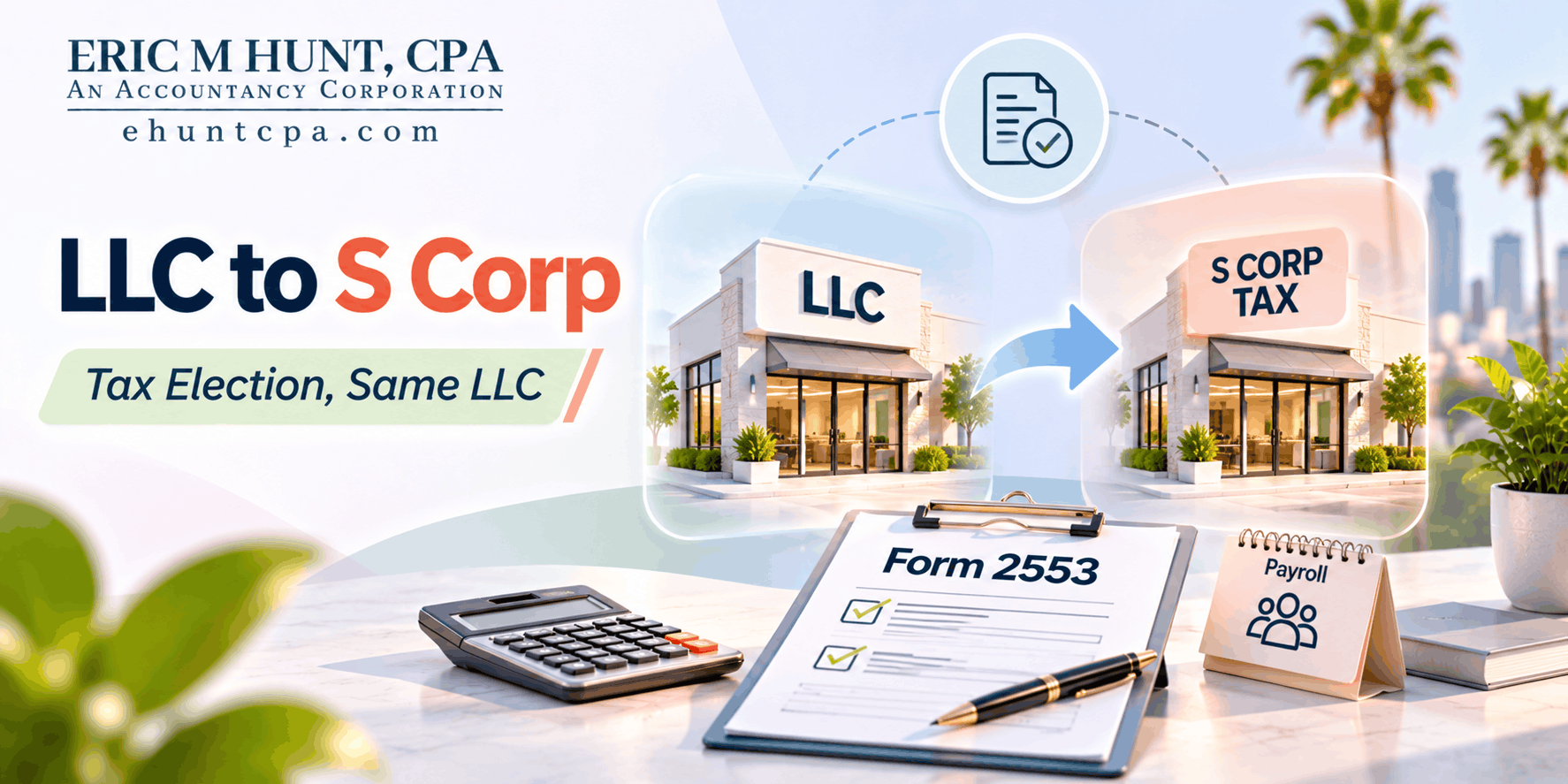
Nothing about your business actually changes. That is the part worth settling before anything else. When you convert LLC to S Corp status, your LLC stays an LLC with the Secretary of State. The operating agreement stands, the contracts stand, the bank account stands, and in almost every case the EIN stands. You are not converting a legal entity. You are filing one IRS form that changes how the business is taxed, and nothing else moves.
There is no state filing for this in California. There is no new entity, no transfer of assets, no second EIN. What there is instead is a deadline that is easy to miss, a payroll obligation that starts immediately, and a savings calculation that most articles overstate because they stop before the state tax and the QBI deduction enter the picture.
What does converting an LLC to an S corp actually mean?
Short answer: it is a tax election, not a legal conversion. One form, filed with the IRS.
An LLC has no default tax identity of its own. The IRS looks through it, treating a single-owner LLC as a disregarded entity and a multi-owner LLC as a partnership. S corporation status is simply a third option you can ask for.
You ask by filing Form 2553. From the effective date forward, the IRS taxes the business under subchapter S rules. The LLC continues to exist under state law exactly as before, which is why how LLCs are taxed in California still matters after the election rather than becoming irrelevant.
One practical point that trips people up and costs them a filing. You do not need Form 8832 as well. An LLC that files Form 2553 is deemed to have elected corporate classification at the same time, so the single form does both jobs. Plenty of guidance tells people to file both, and it is wrong.
Is your LLC eligible to elect S corp status?
Short answer: most small LLCs are. The usual disqualifier is a foreign owner.
The requirements are narrow, and they are absolute. Fail one and the election is invalid rather than merely inconvenient.
-
It has no more than 100 shareholders. Family members can be counted as one.
-
Owners are individuals, estates, exempt organizations, or certain qualifying trusts. Another LLC, a partnership, or a corporation as a member disqualifies you.
-
There are no nonresident alien owners, with a narrow exception for potential current beneficiaries of an electing small business trust.
-
There is only one class of stock. Economic rights must be uniform, so an operating agreement with preferred returns or tiered distributions needs looking at before you file.
-
It is not an ineligible corporation, meaning certain banks using the reserve method for bad debts, DISCs, and insurance companies taxed under subchapter L.
The one that catches people in practice is the nonresident alien rule, usually where a spouse or a silent investor lives abroad. The one that catches people quietly is the single class of stock requirement, because an operating agreement drafted for a partnership often contains exactly the kind of unequal distribution language that breaks it.
How to Convert LLC to S Corp Step by Step
Seven steps. Two of them happen before you touch the form, and skipping those is how people end up with an election that costs more than it saves.
Step 1: Confirm you qualify
Run the eligibility list above against your actual membership, not your intended membership. Read the distribution clauses in your operating agreement while you are there.
Step 2: Run the numbers first
Work out the savings before you file, not after. The sections below give you the arithmetic. An election made on a hunch at $45,000 of profit usually loses money once payroll and the extra return are paid for.
Step 3: Complete Form 2553
The form asks for the entity details, the effective date, the tax year, and information on every owner, including their share and acquisition date. The effective date on line E is the one to get right, because the deadline is measured against it, and so is late relief if you need it later.
Step 4: Get every owner to sign
Every shareholder must consent, and an unsigned form is not a late form; it is not a filed form. If an owner holds their interest as community property, the spouse has to sign too, which catches married owners in California constantly. A corporate officer signs the form itself.
Step 5: File by the deadline
Fax or mail it to the service center for your state. Fax is the practical choice because you keep a transmission confirmation, and that confirmation is what you will want if the IRS later has no record of the filing. Keep a dated copy either way.
Step 6: Start payroll from the effective date
This is the step people postpone and then regret. Once the election is effective, the owner working in the business is an employee and has to be paid a wage with withholding and payroll tax deposits. You cannot wait until the acceptance letter arrives, and you cannot fix a whole year of missed payroll with one December paycheck without inviting questions.
Step 7: Watch for the acceptance notice
The IRS says you should generally hear within 60 days. Acceptance comes as a CP261 notice confirming the date your S corporation treatment begins. If nothing arrives, follow it up rather than assuming, because an election the IRS has no record of is one you will be arguing about at filing time.
What is the Form 2553 deadline?
Short answer: two months and fifteen days after the start of the tax year it applies to, so March 15 for a calendar year business.
There are two windows, and either one works. You can file no more than 2 months and 15 days after the beginning of the tax year the election is to take effect, or at any time during the tax year preceding the one it takes effect.
| Situation | Deadline | Note |
|---|---|---|
| You want S status for all of 2027 | By March 15, 2027 | Or any time during 2026 |
| You formed the LLC on April 10, 2027 and want S status from day one | By June 24, 2027 | 2 months and 15 days from the start of the first tax year |
| You file on April 2, 2027, for calendar year 2027 | Too late for 2027 | Either take 2028, or ask for late relief for 2027 |
One restriction on filing early. A brand new entity cannot file before its first tax year begins. The IRS gives the example of a corporation whose first tax year starts on January 7, where an election made before January 7 is simply not valid. Form on the right side of your start date, then file.
What if you missed the deadline?
Short answer: relief is routine if you have a real reason and you ask within three years and 75 days.
Revenue Procedure 2013-30 exists because late S elections are extremely common. It is not a hardship provision, and you do not need a dramatic story.
You generally qualify if you intended to be an S corporation from the effective date you are asking for, you failed to qualify as an S corporation solely because the election was late, you have reasonable cause for the delay and acted promptly once you noticed, and you are filing within 3 years and 75 days of that intended effective date.
Mechanically, write FILED PURSUANT TO REV. PROC. 2013-30 across the top margin of the first page of Form 2553 and attach a statement explaining the reasonable cause. If you are attaching the late form to a Form 1120-S, the top of that return needs its own line saying it includes a late election filed under the same revenue procedure.
Reasonable cause here means something plausible and honest. Relying on a professional who did not file it, or not knowing the election had to be made separately, both show up regularly, and both are accepted. Filing returns consistently with S treatment in the meantime helps considerably.
How much do you actually save?
Short answer: the payroll tax on whatever you do not pay yourself as salary, minus a QBI cost most articles ignore.
The mechanism is simple. A profitable LLC owner pays self-employment tax of 15.3 percent on 92.35 percent of net profit. Elect S status, and the profit splits into a W-2 salary, which carries payroll tax, and distributions, which do not. The saving is the payroll tax on the distribution half.
Here is the arithmetic at four profit levels, using a 50 percent salary split as an illustration rather than a rule.
| Net profit | Self-employment tax as an LLC | Illustrative salary | Payroll tax as an S corp | Payroll tax saved |
|---|---|---|---|---|
| $50,000 | $7,065 | $25,000 | $3,825 | $3,240 |
| $80,000 | $11,304 | $40,000 | $6,120 | $5,184 |
| $100,000 | $14,130 | $50,000 | $7,650 | $6,480 |
| $150,000 | $21,194 | $75,000 | $11,475 | $9,719 |
Now the part that national articles leave out, and it is not small. Wages paid to you as an S corporation owner are not qualified business income, so every dollar of salary shrinks the income eligible for the 20 percent Section 199A deduction. Take $50,000 as salary, and you have removed $50,000 from QBI, which costs you a $10,000 deduction. In a 22 percent bracket, that is roughly $2,200 of extra income tax, which turns a $6,480 payroll saving into something closer to $4,280 before you have paid for anything.
That cuts both ways, and the direction depends on your income. Below the Section 199A phase-in thresholds, which now sit at $75,000 for single filers and $150,000 on a joint return, the W-2 wage limitation does not apply, so salary simply reduces your deduction. Above those thresholds, the wage limitation comes into play, and having W-2 wages on the books can preserve a deduction you would otherwise lose. Which side of that line you sit on changes the answer, which is exactly why the calculation has to be yours rather than borrowed from an article.
The California Layer: 1.5 Percent and the $800 Floor
Short answer: smaller than most articles claim, because California already charged your LLC $800 a year.
California taxes every S corporation with California source income at 1.5 percent, with an annual minimum franchise tax of $800. The minimum is owed whether the corporation is active, inactive, or operating at a loss. The return is Form 100S, due the 15th day of the 3rd month after the close of the taxable year.
Two corrections matter here, and together they change the conclusion that most comparisons reach.
First, the 1.5 percent applies to the S corporation net income, which is calculated after your salary is deducted as a business expense. Applying 1.5 percent to your whole profit, as most tables do, overstates the tax. On $150,000 of profit with $75,000 taken as salary, the corporation nets roughly $75,000, and the tax is about $1,125, not the $2,250 you get by taxing the full amount.
Second, and more important, your LLC was already paying California $800 a year before you elected anything. An LLC owes an $800 annual tax. An S corporation owes an $800 minimum franchise tax. The floor exists on both sides, so it is not a new cost of electing. What is new is only the amount by which 1.5 percent exceeds that floor, and 1.5 percent does not pass $800 until the corporation nets about $53,300.
| Net profit | Illustrative salary | California tax as an S corp | What the LLC already paid | Extra California cost |
|---|---|---|---|---|
| $50,000 | $25,000 | $800 | $800 | $0 |
| $80,000 | $40,000 | $800 | $800 | $0 |
| $100,000 | $50,000 | $800 | $800 | $0 |
| $150,000 | $75,000 | $1,125 | $800 | $325 |
So the California layer is real but modest at the profit levels where most people are weighing this, and it only starts to bite meaningfully well past $150,000. For the state-specific walkthrough, including the eligibility rules in more depth, the California walkthrough covers that ground separately.
What counts as a reasonable salary?
Short answer: what you would have to pay someone else to do your job. It comes before distributions, not after.
This is the requirement that decides whether the election survives scrutiny, and there is no formula in the code. The standard is what comparable businesses pay for similar work, judged on your duties, hours, experience, and what the business could not run without.
The percentage rules of thumb that circulate, the 50 percent split used in the tables above among them, are modeling conveniences and nothing more. A consultant billing their own time is nearly all labor and supports a high salary ratio. A business whose profit comes substantially from equipment, staff, or capital supports a lower one. Paying yourself $20,000 on $200,000 of profit because a blog post suggested a ratio is the fastest way to have the whole arrangement recharacterized.
Document the figure when you set it rather than reconstructing it later. Note the comparable salary data you looked at, the duties you perform, and the hours. Then run it through payroll on a regular schedule. A reasonable salary paid as one lump in December looks exactly like what it is.
What an S Corp Costs to Run
Short answer: roughly $1,200 to $4,000 a year in compliance, which is what sets the break-even.
The election buys you a tax saving and sells you an administrative burden. Pricing varies by provider and complexity, but the realistic shape is this.
| Item | Typical range | What it covers |
|---|---|---|
| Payroll service | $500 to $2,000 a year | Filing and depositing payroll taxes, W-2 at year-end |
| Form 1120-S preparation | $500 to $1,500 a year | A second return the LLC never had to file |
| Additional bookkeeping | $200 to $500 a year | Payroll and distributions have to be tracked separately |
| Total | $1,200 to $4,000 a year |
Put that against the savings table, and the picture is clear enough. At $50,000 of profit, the $3,240 payroll saving is largely consumed by compliance and the QBI cost, and the election can easily end up negative. At $100,000, it works comfortably. At $150,000, it works well. And remember that making the franchise payment continues either way, so that is not part of the comparison.
What You File After the Election
Short answer: a corporate return, quarterly payroll filings, annual wage forms, and a state return. None of this existed before.
The compliance calendar is the real change in your life. Owner estimated payments continue in your own name alongside all of it, because the distributions still reach your personal return.
| Filing | What it is | When |
|---|---|---|
| Form 1120-S | S corporation return, with a Schedule K-1 for each owner | 15th day of the 3rd month after year end |
| Form 941 | Quarterly payroll tax return | End of the month following each quarter |
| Payroll deposits | Withheld and employer payroll taxes | Monthly or semiweekly, by your deposit schedule |
| W-2 and W-3 | Owner wage reporting | January 31 |
| Form 100S | California S corporation return | 15th day of the 3rd month after year end |
| Personal estimates | Your own quarterly payments on the distributions | April 15, June 15, September 15, January 15 |
When does electing make sense, and when does it not?
Short answer: once profit is consistently past roughly $80,000, with the qualifier that consistency matters as much as the number.
The honest threshold is where the payroll tax savings comfortably clear compliance costs plus the QBI cost plus any California tax above the floor. On the numbers above, that lands somewhere around $80,000 of steady profit, lower if your compliance costs are at the cheap end, higher if the QBI effect hits you hard.
Three things argue for waiting even when the arithmetic looks favorable. Lumpy income is the main one, because the payroll obligation does not pause in a bad year and neither does the $800. Businesses expecting a large equipment purchase or a loss year should model that year specifically. And if you have no appetite for running payroll properly, the election creates an obligation you will probably meet badly, which is worse than not making it.
Three things argue for electing sooner. Profit that is growing and predictable. A business where your own labor clearly drives the income, which makes the reasonable salary question easy to answer. And the simple fact that the savings recur every year, so the earlier a genuinely profitable business elects, the more years it compounds over.
Can you undo an S corp election?
Short answer: you can revoke it, but getting back to ordinary LLC taxation is usually blocked for five years.
Revoking the S election itself is straightforward. You file a revocation statement with the consent of shareholders holding more than half the shares, and the IRS confirms the change with a CP262 notice.
Getting back to where you started is the harder half. By filing Form 2553, your LLC was deemed to elect classification as a corporation. Once an LLC changes its classification, it cannot elect to change again during the 60 months after the effective date of that election. So revoking the S election does not simply return you to partnership or disregarded treatment. It generally leaves you taxed as a C corporation, which for a small business is usually worse than where you began.
One exception is worth knowing, and it rewards planning. If the classification election took effect on the date the LLC was formed, that is not treated as a change for the purpose of the 60-month limitation. An LLC that elects S status from day one is therefore in a different position from one that elects three years in. If you are forming an entity and already expect S treatment, electing at formation is cleaner than electing later.
Either way, treat this as close to a five-year commitment rather than something to try for a year. That is the main argument for running the numbers properly before filing instead of after.
Frequently Asked Questions
Can an LLC be an S corp?
Yes. S corporation is a tax status rather than an entity type, so an LLC can elect it by filing Form 2553 while remaining an LLC under state law. The LLC must meet the S corporation requirements: no more than 100 owners, only eligible owner types, no nonresident alien owners, and a single class of ownership.
Can I convert my LLC to an S corp when filing my tax return?
Sometimes, through late election relief. A timely Form 2553 is due before the return, but Revenue Procedure 2013-30 lets you attach a late election to Form 1120-S if you intended S treatment from the effective date and have reasonable cause. Write the required Rev. Proc. 2013-30 wording on both the form and the return.
When should I convert my LLC to an S corp?
Once net profit is consistently above roughly $80,000, which is where the payroll tax savings reliably clear compliance costs, the QBI effect, and any California tax above the $800 floor. Consistency matters as much as the figure, because payroll obligations do not pause in a weak year.
What is the deadline to convert an LLC to an S corp?
No more than 2 months and 15 days after the start of the tax year the election takes effect, which is March 15 for a calendar year business, or any time during the preceding tax year. A newly formed LLC gets 2 months and 15 days from the start of its first tax year, and cannot file before that year begins.
How much do you save converting an LLC to an S corp?
The payroll tax on whatever is not paid as salary. On $100,000 of profit with a $50,000 salary, that is about $6,480 of payroll tax, reduced by roughly $2,200 because salary is not qualified business income, then further reduced by $1,200 to $4,000 of compliance costs. The realistic net is a few thousand dollars.
Do I need a new EIN to convert my LLC to an S corp?
No, in almost every case. The LLC is the same legal entity before and after the election, so the existing EIN carries over. You also do not need Form 8832, because filing Form 2553 is treated as electing corporate classification at the same time, and filing both is a common and unnecessary step.
Can I convert my LLC to an S corp mid-year?
Only in limited circumstances. The election normally takes effect at the start of a tax year, and the deadline is measured from that start. A newly formed LLC can elect from its formation date mid-year. An existing LLC that misses the window generally takes effect the following year, or requests late relief for the year it wanted.
How much salary should I pay myself as an S corp?
Whatever you would have to pay someone else to do your job, based on duties, hours, and comparable market pay. There is no statutory percentage. The 50 percent split used in illustrations is a modeling convenience, not a safe harbor, and salary must be paid before distributions rather than as a year-end adjustment.
Does my LLC still exist after electing S corp status?
Yes, entirely unchanged. The election affects federal and state tax treatment only. Your LLC remains an LLC with the Secretary of State, the operating agreement and contracts stand, the liability protection is the same, and the bank account and EIN carry on as before.
Can I undo an S corp election?
You can revoke it with the consent of more than half the ownership, but you usually cannot return to ordinary LLC taxation straight away. Filing Form 2553 also elected corporate classification, and that cannot be changed again for 60 months, so revoking generally leaves you taxed as a C corporation instead.
The decision to convert llc to s corp status comes down to one question that no general article can answer for you: whether your profit is high enough, and steady enough, that the payroll tax saved outweighs payroll run properly, a second return, the lost QBI, and the California tax above the floor. Get that number right, and the election pays every year you keep it. Get it wrong, and you have bought yourself five years of obligations for a saving that was never there. Run it on your own figures before March 15, not after.