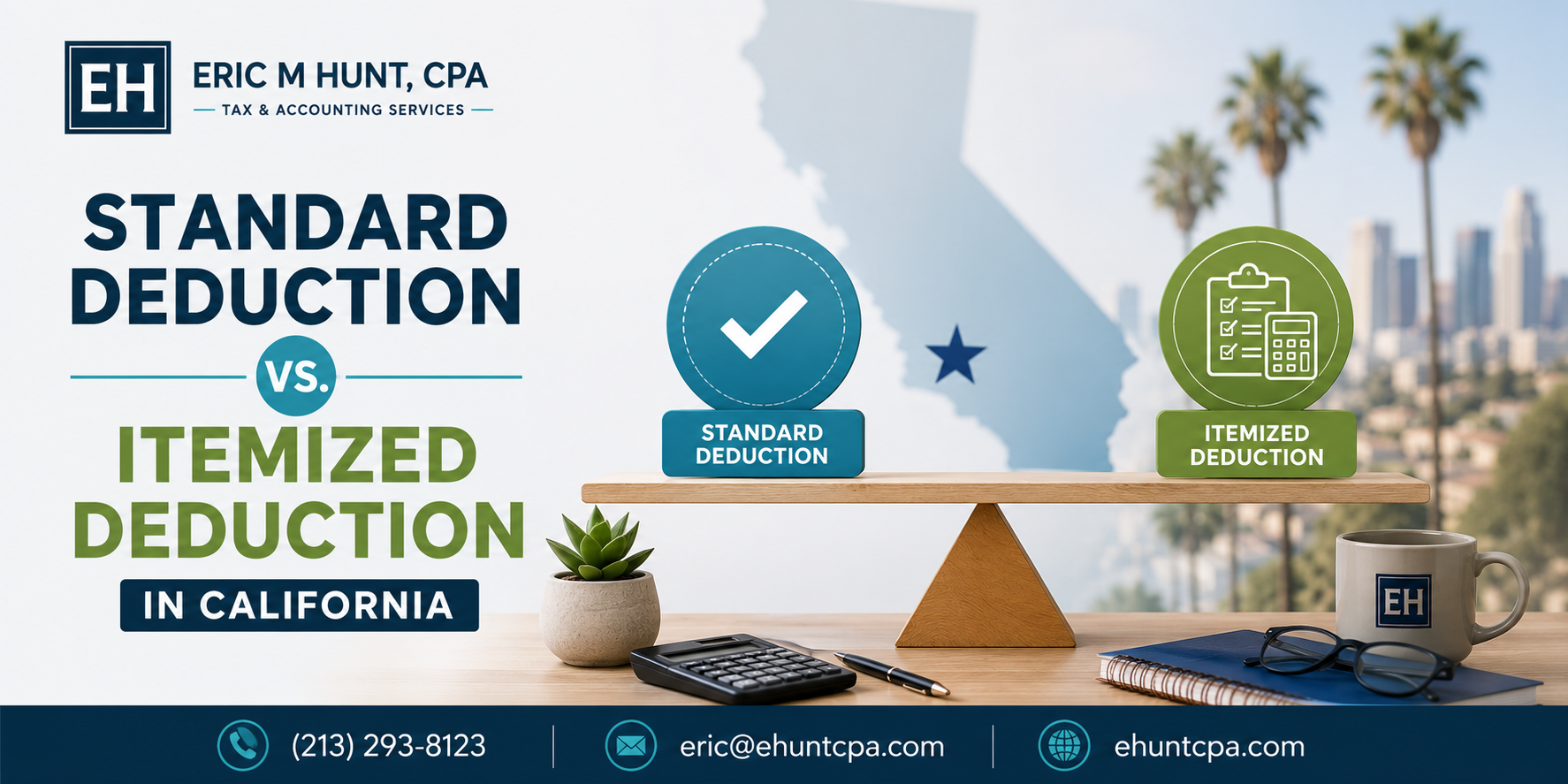
Every year, thousands of California taxpayers lose their money because they choose the standard deduction and don’t have proper records of their spending. On the other hand, some people spend hours collecting receipts for itemized deductions, but they are unable to save the money they would save with the standard deduction.
It is not easy to choose between the standard deduction vs itemized deduction in California, because it is different for everyone. It depends on your income, whether you own a home, how much you give to charity, and a handful of California-specific rules that make people confuse every single tax filing season.
Below, we have mentioned things you actually need to know before you file your 2026 California return.
First, Understand That California Plays by Its Own Rules
Many people think California just follows whatever they did on their federal tax return. But that is not true. California has its own deduction amounts and rules, which are quite different from federal rules. So the choice that saves you money on your federal return may actually cost you more on your California return. That is why it is worth taking a few minutes to understand both before you file.
The California Standard Deduction for 2026
The standard deduction is a fixed amount that is deducted from your taxable income, and it does not require any receipts. It is straightforward, fast, and works well for people whose actual expenses are not much.
For 2026, here is what California allows:
| Filing Status | California Standard Deduction |
| Single | $5,850 |
| Married Filing Jointly | $11,700 |
| Married Filing Separately | $5,850 |
| Head of Household | $11,700 |
| Qualifying Widow(er) | $11,700 |
Now, here is where California gets interesting. The federal standard deduction for 2026 is $15,000 for single filers and $30,000 for married couples. That is a gap of more than $9,000 for a single filer. So even if you took the federal standard deduction, you might still be better off itemizing on your California Form 540.
Also worth noting – unlike the federal return, California does not give seniors or blind taxpayers any additional standard deduction. If that applies to you, keep it in mind.
What You Can Deduct If You Itemize in California
When you make a list, you replace that fixed amount with your real expenses – things like mortgage interest, property taxes, and medical bills. If those expenses exceed your standard deduction, itemizing saves you more money. For most California homeowners, they usually do.
Mortgage Interest
You can deduct interest on your primary home plus one other property. California is actually more generous here than federal law – it allows the deduction on mortgage debt up to $1,000,000, compared to the federal cap of $750,000. And starting in 2026, private mortgage insurance (PMI) premiums are deductible again after being permanently restored under the One Big Beautiful Bill Act (OBBBA).
State and Local Taxes (SALT)
For a long time, you could only deduct up to $10,000 in state and local taxes, which felt unfair for Californians who pay some of the highest property taxes in the country.
That changed in 2025.
A new federal law raised that limit to $40,000, and it stays that way through 2029. If you earn over $500,000, the limit starts to shrink, but for most California taxpayers, this is a welcome change that makes itemizing much more worthwhile.
Medical and Dental Expenses
Medical expenses are deductible, but there is a catch – you can only deduct the portion that goes over 7.5% of your income. For example, if you earned $80,000, the first $6,000 of medical bills does not count. Only what you spent above that amount is deductible. If you had a surgery, major dental work, or a serious health condition during the year, it is worth adding up your bills.
Charitable Contributions
California follows federal rules here for the most part, capping the deduction at 50% of your federal AGI. However, starting in 2026, there is a new 0.5% floor on charitable deductions based on AGI. On a $100,000 income, your first $500 in donations does not generate any deduction. It is a small change but worth knowing.
Casualty Losses
If you were affected by a federally declared disaster – like the 2025 Los Angeles wildfires – you may be able to deduct uninsured losses that exceed 10% of your AGI. This is one deduction many people forget entirely.
What California Does NOT Allow
A few deductible things federally get disallowed on your California return:
- California does not let you deduct state income taxes withheld from your paycheck
- Miscellaneous deductions subject to the old 2%-of-AGI floor are gone permanently under OBBBA
- Some charitable donation rules differ from federal treatment, so the amounts may not match line-for-line
So Which One Should You Choose?
There is no universal right answer. It comes down to one simple test: add up your itemizable expenses and see if they beat your standard deduction.
Take the standard deduction if:
- You rent your home and do not have big medical or charitable expenses to claim
- Your total qualifying expenses are less than $5,850 as a single filer or $11,700 if you are married filing jointly
- You want a quick and simple filing process without hunting down receipts and paperwork
Consider itemizing if:
- You own a home and are paying mortgage interest and property taxes
- You had big out-of-pocket medical bills during the year
- You made meaningful charitable contributions
- You were affected by a California wildfire or other declared disaster
- You are a higher earner, where each dollar deduction reduces a larger tax bill
To put real numbers to it: say you are a single filer earning $85,000, paying $12,000 in mortgage interest and $4,000 in property taxes. Your itemized total is $16,000 – well above the $5,850 standard deduction. At California’s 9.3% marginal rate, itemizing saves you roughly $944 in state taxes alone.
That is nothing.
Can You Itemize in California Even If You Took the Federal Standard Deduction?
Yes – and this surprises a lot of people.
Because California’s standard deduction is so much lower than the federal amount, you can itemize on your California Form 540 even if you did not itemize on your federal return. For homeowners, especially, this is a strategy worth exploring every year.
The reverse is not true, though. If you itemized on your federal return, you have to itemize on your California return as well.
High Earners: There Is an Extra Layer
If your income pushes you into the top federal bracket ($626,350+ for single filers), be aware that a new limitation reinstated in 2026 under the OBBBA reduces your total itemized deductions by a calculated amount based on how far your income exceeds that threshold. California has its own separate limitation that applies on top of this.
For taxpayers in Los Angeles or the Bay Area in the highest brackets, you could be hit with a double reduction – once federally, once at the state level. This is where working with a CPA goes from a convenience to a genuine necessity.
Mistakes People Make Every Year
A few things we consistently see cost California taxpayers money:
- Assuming California follows federal rules. It does not, at least not fully. Always evaluate your state return separately.
- Not checking both options. If you used tax software last year, it likely made this comparison automatically. But if you filed manually or had someone else do it without walking through your deductions, there is a real chance you missed savings.
- Forgetting the SALT cap changed. If $10,000 used to make itemizing not worth it for you, the new $40,000 cap changes the math completely. Run the numbers again this year.
- Skipping documentation. If you plan to itemize, keep your Form 1098 for mortgage interest, your property tax bills, and your charitable donation receipts. Without records, you cannot support the deductions if the FTB asks.
The Bottom Line
Deciding between the standard deduction vs itemized deduction in California comes down to your actual expenses – not assumptions, not what you did last year, and not what worked for your neighbor. With California’s rock-bottom standard deduction and the new $40,000 SALT cap changing the equation for many homeowners, 2026 is a year where running the comparison is genuinely worth your time.
If you want to make sure you are choosing the right option and not missing deductions you qualify for, the team at Eric M. Hunt, CPA, is here to help. We work with California residents, homeowners, entertainers, and self-employed professionals to make tax filing less stressful and more strategic. Reach out to schedule a consultation.
Frequently Asked Questions
Q1. What is the California standard deduction for 2026?
It is $5,850 for single filers and $11,700 for married filing jointly – far lower than the federal amounts.
Q2. Can I itemize on my California return if I took the standard deduction on my federal return?
Yes. California allows it, and for many homeowners, it is the smarter move given the state’s low standard deduction.
Q3. How does the new $40,000 SALT cap affect my decision?
It makes itemizing more worthwhile for California homeowners who pay high property and state income taxes – many can now deduct far more than the old $10,000 limit allowed.
Q4. Does California allow any itemized deductions that the federal government does not?
Yes, California allows mortgage interest on debt up to $1,000,000 (vs. the federal $750,000 limit) and some deductions for utility loan interest and unreimbursed employee expenses.
Q5. Is it worth itemizing if I am only slightly above the standard deduction?
Usually yes, though weigh the time to gather documentation against the actual savings at California’s tax rates, even a few hundred dollars in extra deductions can mean real money back.