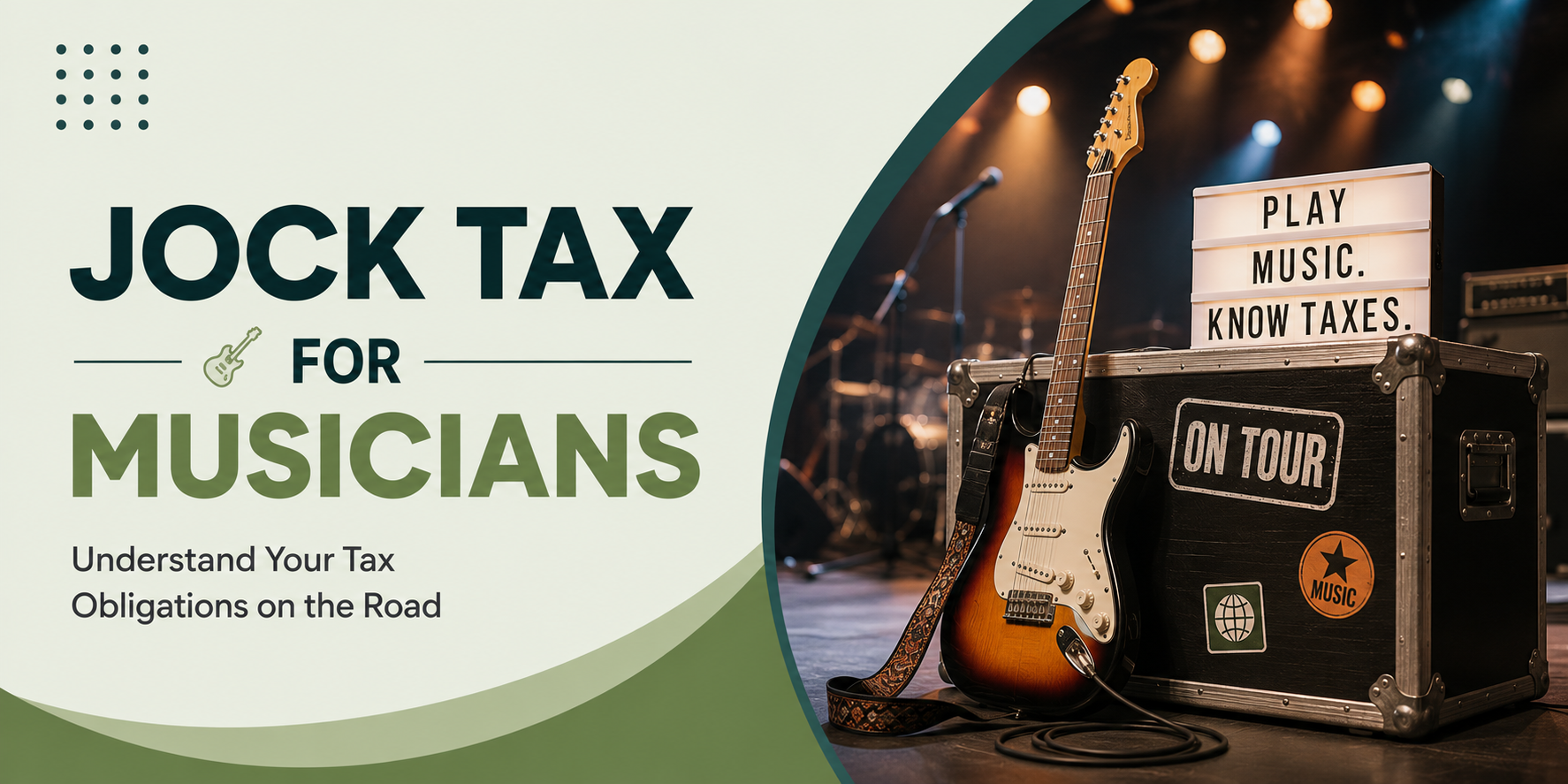
A four-piece band from Nashville plays two sold-out nights in Los Angeles. Before the money even reaches their bank account, California has already taken a cut, and each member now has a state tax return to file in a state none of them live in. That is the jock tax for musicians at work, and despite the name, it was never just about athletes.
The term started in sports, but the rule behind it reaches every performer who earns money away from home. Touring musicians, actors shooting on location, comedians on the road, session players, and the crew traveling with them all fall under the same tax treatment. If you perform for pay in a state where you do not live, that state usually wants a slice of what you earned there. This page explains how that works, what it costs, and where the jock tax catches musicians off guard most often.
What the Jock Tax Actually Is
The jock tax is not a real line in the tax code. There is no statute called the “jock tax.” It is a nickname for the way states apply their ordinary nonresident income tax to people who travel for work and earn money inside their borders.
Here is the principle underneath it. Your home state taxes everything you earn, no matter where you earn it. But other states can also tax the portion of your income that you earned while physically working inside them. For most workers, this never comes up because they do the whole job from one place. For a touring performer who earns money in fifteen states in a single year, it comes up fifteen times.
The nickname was born in 1991. After the Chicago Bulls beat the Lakers for the NBA title, California billed Michael Jordan for state tax on the days he spent playing in Los Angeles. Illinois fired back with its own version aimed at athletes from any state that taxed Illinois players. The press called it the jock tax, the name stuck, and states spent the next three decades expanding how aggressively they enforce it. Today, the tax reaches far past basketball courts and into every green room and recording studio where an out-of-state performer gets paid.
How the Jock Tax for Musicians Is Calculated: The Duty-Day Formula
States do not tax your whole year’s income. They tax the share of it that belongs to work you did inside their borders, and most of them figure out that share using something called duty days.
A duty day is any day you spend working for the income in question. For a musician, that includes the show itself, travel days, rehearsals, soundcheck, promotional appearances, and press. It is not just the two hours you spend on stage. The full working footprint counts.
The math works as a ratio. Take the number of duty days you spent in a state, divide by your total duty days for the year, and multiply that fraction by your income. The result is how much of your income the state can tax.
Say a touring musician has 200 total duty days in a year and earns $300,000 from touring. During that year, they spent 6 duty days in California, two show days plus travel, rehearsal, and a promo appearance. The calculation looks like this:
| Step | Figure |
|---|---|
| California duty days | 6 |
| Total duty days for the year | 200 |
| California’s share of income | 6 ÷ 200 = 3% |
| Touring income for the year | $300,000 |
| Income taxed by California | 3% × $300,000 = $9,000 |
So California taxes $9,000 of that musician’s income, and they owe California tax on that amount at California rates. Every other state they performed in runs its own version of the same calculation. The numbers are small per state, but they add up, and each one can mean a separate tax return.
Does the Jock Tax Apply to Musicians and Other Performers?
Yes, fully. This is the part that surprises people because the name suggests athletes, while the rule covers a much wider group.
The nonresident income tax that athletes pay is the same one that applies to touring musicians, actors, directors working on location, comedians, dancers, and public speakers. California’s own withholding rules name entertainers, athletes, and speakers in the same breath. A guitarist playing a festival in another state is in the same tax position as a shortstop playing an away game there.
This got a public confirmation in 2025. When the Pennsylvania Supreme Court struck down Pittsburgh’s version of the tax, the case was not only about athletes. The tax it examined applied to nonresident “athletes and entertainers” alike, performers who earned money at the city’s publicly funded venues. Courts, states, and cities treat the touring musician and the visiting athlete under one framework.
For a working performer, the practical takeaway is simple. If you get paid to perform in a state where you do not live, assume that state has a claim on the income you earned there, and plan for it before the money comes in rather than after. This is one of several reasons touring musicians benefit from a tax accountant who understands how performance income actually flows.
The California Jock Tax: The Most Aggressive in the Country
California is where this whole thing started, and it remains the state that performers need to watch most closely. It has the highest state income tax rates in the country, running from 1 percent up to 13.3 percent, and it enforces its nonresident rules harder than almost anywhere else.
For performers, California adds a step that catches many touring acts by surprise: withholding at the source. When a nonresident performer or their company is paid more than $1,500 in a calendar year for California work, the venue or payer is required to withhold 7 percent of the gross payment and send it to the California Franchise Tax Board. That happens before you ever see the money.
Here is where it stings on cash flow. The 7 percent comes out of the gross, not the net. A band paid $40,000 for a California run could have $2,800 held back on the spot, regardless of what the show actually cost them to put on. If touring expenses ate most of that fee, the withholding can be larger than the profit.
The fix is planned, and California gives you the tools if you use them ahead of time. Consider a band earning $50,000 across a ten-city tour with two shows in California. Left alone, the payer might withhold 7 percent on payments tied to those California dates. But if the band files the right paperwork with the Franchise Tax Board showing that only $10,000 of the tour income is genuinely allocable to California, the withholding drops from around $3,500 to roughly $700. The forms exist to reduce or waive the withholding, but they have to be filed before payment, not after.
A few California specifics worth knowing:
- The withholding rate is a flat 7 percent on gross California-source payments over $1,500 in the year.
- You reduce or waive it by filing FTB Form 589 for reduced withholding or Form 588 for a waiver, and you need approval before the payment is made.
- At year’s end, the payer sends you Form 592-B showing what California withheld, which you use when you file.
- Nonresident performers file a California return on Form 540NR to report the California-source income and claim credit for the tax already withheld.
Because California taxes this income at some of the highest rates in the country, it helps to understand the brackets that apply, which our California state income tax guide lays out in full.
For musicians and performers with any real California touring income, this is exactly the kind of thing worth handing to a CPA who knows the entertainment world, because the difference between planning ahead and cleaning up afterward is often thousands of dollars in tied-up cash.
Who Else Gets Hit Besides the Headliner
The jock tax is not only a problem for the star names but also quietly affects people who are not earning star money.
Everyone traveling with a tour to earn income can fall under the same rules. Backing musicians, sound engineers, tour managers, lighting techs, and merchandise sellers all perform work in each state the tour visits, which means each of them can owe nonresident tax and face filings in multiple states. A session drummer on a modest per-show rate can end up owing small amounts across a dozen states, each requiring its own return, with compliance costs that eat into already thin pay.
The same logic applies well beyond music. A writer flown to another state for a shoot, a producer working on location, a freelance director splitting a project across state lines, all of them can pick up nonresident tax obligations in places they never think of as home. The income does not have to be huge for the filing requirement to exist. That mismatch, real filing burden on modest income, is the least understood part of the whole system.
What Changed in 2025: The Pittsburgh Ruling
The biggest recent development in this area came in September 2025, and it matters for anyone watching where these taxes are headed.
On September 25, 2025, the Pennsylvania Supreme Court struck down Pittsburgh’s jock tax as unconstitutional. Since 2005, the city has charged nonresident athletes and entertainers a 3 percent fee on income they earned at its publicly funded venues, while residents paid a lower rate. The court found this violated the Uniformity Clause of the Pennsylvania Constitution, which requires similar taxpayers to be treated the same, and ruled that the city never justified taxing nonresidents more heavily than residents.
The stakes were real. The city had collected roughly $79 million through the fee since 2005, and performers and athletes who paid it may now have grounds to seek refunds. Just as important, the ruling could ripple outward because many other states and cities have similar uniformity provisions in their own constitutions, and this decision provides a roadmap for anyone challenging a comparable tax elsewhere.
For a touring performer, the lesson is not that these taxes are going away. Most are on solid legal ground. The lesson is that the rules shift, sometimes in your favor, and staying current on where you actually owe can put money back in your pocket.
How to Stay on Top of It
The performers who handle this well are not the ones who avoid the tax, since, for the most part, you cannot. They are the ones who track it as they go, rather than reconstructing it in a panic at tax time.
A few habits make the whole thing manageable:
- Keep a running record of where you worked and when. Note every state, the dates, and what you were doing there, since duty days are only defensible if you can show them. A simple calendar or spreadsheet updated after each leg of a tour beats trying to rebuild your year from memory.
- Sort out withholding paperwork before you get paid, not after. In states like California, the forms that reduce withholding only work if they are filed ahead of payment. Once the money is withheld, getting it back means waiting until you file a return.
- Separate performance income from endorsement or royalty income. States tax the income you earn by working inside their borders. Money from endorsements, sponsorships, and most royalties is generally taxed by your home state, not by every state you tour through, so keeping these streams clearly divided keeps you from overpaying.
- Watch the credit for taxes paid to other states. Your home state generally gives you a credit for taxes you paid to other states on the same income, which is what stops you from being taxed twice on the same dollar. Claiming it correctly is where a lot of self-filed returns go wrong.
Short Answer: Do Performers Pay the Jock Tax?
Yes. Any performer who earns money in a state where they do not live generally owes that state tax on the income earned there, calculated by the share of working days spent in the state. Musicians, actors, and other entertainers are covered by the same rules as professional athletes, and high-tax states like California enforce them aggressively through upfront withholding.
Frequently Asked Questions
What is the jock tax?
It is a nickname for the nonresident income tax that states charge people who earn money working inside their borders. It applies to athletes, musicians, actors, and other traveling performers.
How is the jock tax calculated?
States divide the days you worked in the state by your total working days for the year, then apply that fraction to your income to find the amount they can tax.
Does the jock tax apply to musicians?
Yes. Touring musicians and other performers are taxed the same way as athletes on the income they earn performing in states where they do not live.
How much does California withhold from nonresident performers?
California requires 7 percent withholding on gross California-source payments over $1,500 per year, taken before you receive the money, unless you file to reduce or waive it first.
Do you pay jock tax on endorsement income?
Generally no. Endorsement and most royalty income is taxed by your home state, not by every state you perform in, unlike your performance fees.
Can you avoid being taxed twice on the same income?
Usually yes. Your home state typically gives a credit for tax paid to other states on the same income, which prevents double taxation when claimed correctly.
The Bottom Line
The jock tax is one of the messiest parts of earning a living on the road. The income from a single out-of-state show can trigger withholding, a separate state return, and a credit calculation back home, and doing all of that across a full touring year is where a lot of performers either overpay or fall out of compliance without realizing it. The California jock tax makes this sharper than anywhere else, both because of its high rates and its upfront withholding.
If you are a musician, actor, or performer based in Los Angeles earning income across state lines, the jock tax for musicians is worth getting right the first time. An entertainment CPA who works with performers can track your duty days, handle the withholding paperwork before it costs you cash flow, and make sure you are paying what you owe in each state and not a dollar more.