You set aside a slice of every invoice, you plan to settle up with the state in April, and then a penalty notice shows up anyway. That is the trap California builds for anyone whose income does not come with tax already withheld. California estimated tax payments are the state’s way of collecting as you earn, and the rules around them, especially the timing, catch people who were honestly trying to do the right thing.
The good news is that the system is learnable, and once you see how the installments are weighted, you can stop guessing. Here is who owes, how much, when, and how to pay it without handing the state extra money in penalties.
Who has to make California estimated tax payments?
The rule is simpler than it sounds. You owe estimated payments if you expect your California tax bill to be at least $500 after withholding and credits, or $250 if you are married or in an RDP and file separately. Below that, you can settle the whole thing at filing.
In practice, this lands on anyone whose income arrives without withholding. That means freelancers and independent contractors paid on 1099s, consultants, small-business owners taking profit rather than a paycheck, landlords collecting rent, and investors with dividends or investment and property gains. Performers, writers, and musicians living on royalties and project fees are squarely in this group because almost none of that income has state tax withheld before it reaches them.
If you are a W-2 employee with a side business, you can often skip estimated payments by increasing the withholding on your paycheck instead, since withholding counts as paid evenly across the year, no matter when it actually happens. That one move sidesteps the whole schedule for a lot of people.
The Payment Schedule That Catches Everyone
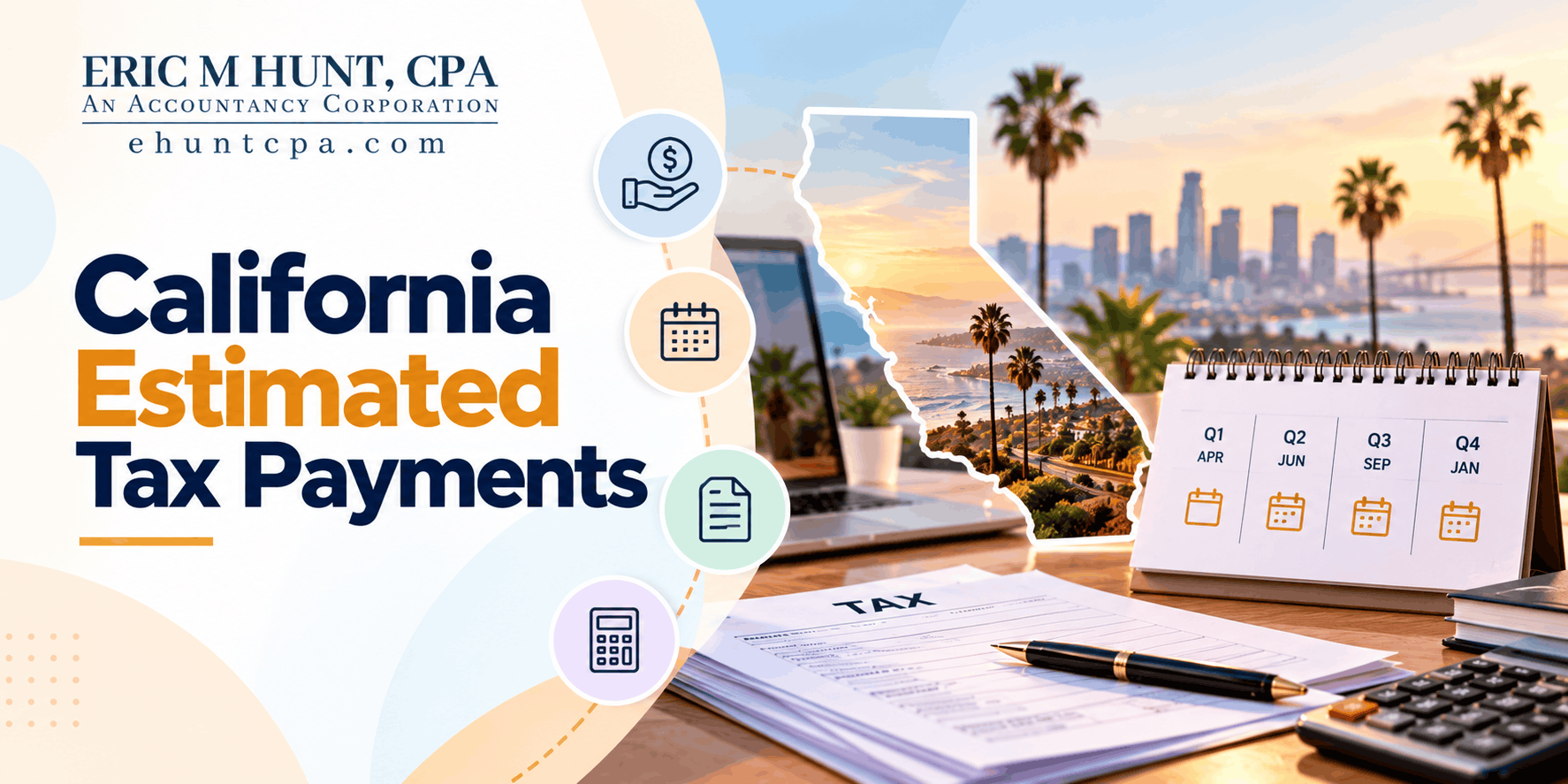
Here is the single most important thing on this page, and the detail that trips up people who assume California mirrors the IRS. The federal system splits estimated tax into four roughly equal quarters. California does not. The state front-loads the year and then skips a quarter entirely.
| Installment | Due date | Portion due | Running total |
|---|---|---|---|
| 1st | April 15, 2026 | 30% | 30% |
| 2nd | June 15, 2026 | 40% | 70% |
| 3rd | September 15, 2026 | 0% (none due) | 70% |
| 4th | January 15, 2027 | 30% | 100% |
By June 15, the state wants 70% of your entire year’s estimate in hand. September 15 appears on the calendar, but no payment is due then. Then the final 30% is due the following January. Anyone who divides their bill into four even payments underpays badly in the first half of the year and gets penalized for it, even if the total is paid by January. The federal schedule differs, so running both on the same quarterly rhythm is a common and expensive mistake.
How Much to Pay: The Safe Harbor
You do not have to predict your income perfectly. California gives you a safe harbor, a floor that protects you from penalties as long as you pay at least that much, spread across the installments above.
The safe harbor is the smaller of two numbers: 90% of what you will owe for the current year, or 100% of what you owed last year. Most people lean on the prior-year figure because it is already known and certain. If your California adjusted gross income last year was over $150,000, or over $75,000 if married filing separately, that prior-year figure rises to 110%.
There is one exception that removes the easy option. If your California AGI reaches $1,000,000 this year, or $500,000 married filing separately, the prior-year safe harbor disappears entirely, and you must base payments on 90% of the current year’s actual tax. High earners with a big one-time event, a business sale, a vesting cliff, or a large royalty advance cannot fall back on last year’s smaller bill. Working out the current-year number starts with the current bracket rates.
A quick illustration. Say you owed $12,000 in California tax last year and your income was under the $150,000 line. Your safe harbor is 100% of that, so $12,000 for the year. Applied to the schedule, that is $3,600 by April 15, $4,800 by June 15, nothing in September, and the last $3,600 by January 15. Pay that much on time, and you are protected from an underpayment penalty, even if you end up owing more when the return is filed.
How do I pay California estimated taxes online?
The state gives you several ways to pay, and for most people, the free electronic option is the right one.
-
Web Pay. The FTB’s free online service pulls the payment directly from your bank account, with same-day or scheduled timing and instant confirmation. This is the cleanest method for most filers.
-
Credit or debit card. Available through the FTB’s third-party processor, but it carries a service fee, so it only makes sense when you need the card float.
-
By mail. Send a check with the Form 540-ES voucher for the matching installment. Slower, and you lose the instant confirmation, but still accepted.
One California rule surprises people and carries its own penalty. Once you make a single estimated or extension payment over $20,000, or you file a return showing total tax over $80,000, you are required to make all future payments electronically. Pay by check after that, and the state adds a 1% penalty on the amount, on top of anything else you owe. The requirement, once triggered, stays with you for good. You can confirm the current thresholds in the FTB Form 540-ES instructions.
What Happens If You Underpay or Pay Late
Miss an installment, or pay less than the safe harbor requires, and California charges an underpayment penalty. It is not a flat fine. The state calculates it like interest, running on the shortfall for each day it stays unpaid, at a rate the FTB resets twice a year. A small miss early in the year quietly grows the longer it sits.
The penalty is figured on Form 5805, which most tax software and preparers handle automatically. The practical takeaway is that the cost of underpaying is real but proportional, so if you miss an installment, the right move is to catch up as soon as you can rather than waiting for April, since every day of delay adds to the charge.
When Your Income Is Lumpy or Unpredictable
The safe harbor assumes you can pay the weighted installments above, but some people genuinely do not know their income early in the year. A writer who signs a large deal in November, a consultant whose work clusters in the back half of the year, a trader with gains that land when they land, would overpay badly if forced to estimate a full year in April.
For them, California allows the annualized income installment method, which lets you pay based on what you have actually earned by each deadline rather than a flat projection. It involves more paperwork and a worksheet, but it can substantially reduce your early installments when income is genuinely back-loaded. This is where proactive tax planning pays for itself, because the method has to be set up correctly to hold up.
Estimated payments go wrong in quiet, expensive ways: the wrong installment weighting, a safe harbor that does not apply, a missed electronic-payment rule. Eric M Hunt, CPA, works with freelancers, business owners, and creative professionals across Los Angeles and builds an estimate schedule you can actually follow, so April holds no surprises and no penalties. Call 213-753-1219 or set up a consultation.
Frequently Asked Questions
How do I pay California estimated taxes?
The simplest way is Web Pay, the FTB’s free online service that debits your bank account directly. You can also pay by credit or debit card for a fee, or mail a check with the Form 540-ES voucher for that installment. If you have exceeded the state’s electronic payment threshold, you must pay online rather than by check.
When are California estimated tax payments due?
Four times across the year: April 15, June 15, September 15, and the following January 15. For the 2026 tax year, the dates are April 15, 2026; June 15, 2026; September 15, 2026; and January 15, 2027. California weights these unevenly rather than splitting them into equal quarters.
What is California estimated tax payment schedule?
California front-loads the year. You pay 30% of the annual estimate by April 15, 40% by June 15, nothing for the September 15 installment, and the final 30% by January 15. By mid-June, the state expects 70% of the full year’s estimate, which is what catches people who assume four equal payments.
How do I pay California estimated taxes online?
Use the FTB’s Web Pay service, which is free and pulls the payment from your bank account with instant confirmation. Card payments are available through the FTB’s processor for a fee. Once you make an estimated or extension payment over $20,000, or file a return with a total tax over $80,000, an electronic payment becomes mandatory.
What is California’s safe harbor rule for estimated taxes?
The safe harbor protects you from penalties if you pay the smaller of 90% of the current year’s tax or 100% of last year’s tax. If your prior-year California AGI was over $150,000 ($75,000 if married filing separately), the prior-year figure rises to 110%. Taxpayers with current-year AGI of $1,000,000 or more must use 90% of the current year and cannot use the prior-year safe harbor.
Which form do I use for California estimated tax?
Form 540-ES, Estimated Tax for Individuals. Each installment has its own payment voucher if you pay by mail. If you pay electronically through Web Pay, the system records the installment for you, and no paper voucher is needed.
California estimated tax payments reward people who plan the weighting rather than the total. Lean on the prior-year safe harbor when it applies, respect the 30/40/0/30 rhythm, pay electronically once you cross the threshold, and the whole thing becomes routine. When your income is uneven or large enough to lose the safe harbor, that is the point to bring in help before a deadline passes, not after.